Claira Stories
The Canadian Discovery Protocol Guide (2026 edition)
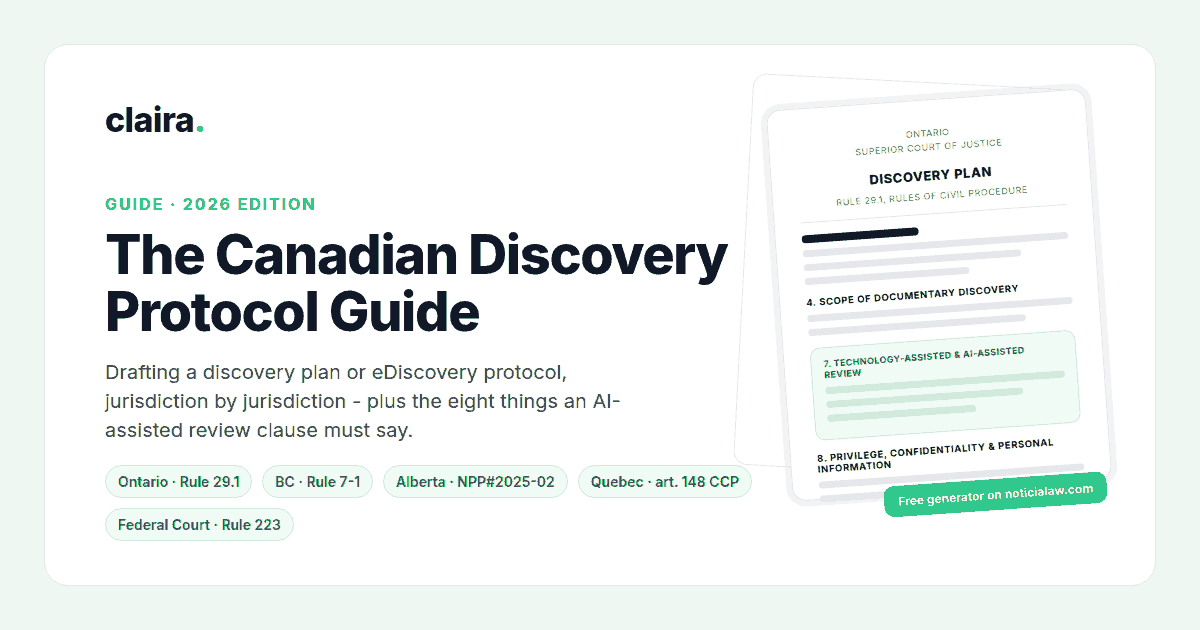
Created by Claira and the team at Noticia. Rules and sources current to 18 August 2026. This guide is general information for litigators and litigation-support professionals; it is not legal advice.
Want the document, not the reading? The free Canadian Discovery Protocol Generator on noticialaw.com turns this guide into a jurisdiction-specific Word template in about ten minutes. Everything below explains the choices the generator makes, so you can defend each clause when the other side asks why it is there.
1. Why every Canadian case needs a written discovery protocol
Discovery is where civil litigation spends most of its money and most of its delay. Canadian courts have said so for years, and the procedural rules in every major jurisdiction now push the parties to plan discovery cooperatively and proportionately before anyone starts collecting email. In Ontario the plan is mandatory (Rule 29.1). In Quebec the case protocol is mandatory and must address pre-trial examinations and the disclosure of exhibits (arts. 148 and 246 CCP). In Alberta a litigation plan has been mandatory in every civil (non-family) action since 1 September 2025 (NPP#2025-02). In British Columbia and the Federal Court the vehicle is case planning or case management, but the content - who, what, when, and in what format - is the same.
A discovery plan (Ontario's term) and an eDiscovery protocol (the industry's term) do slightly different jobs. The plan answers the rules' questions: what is the scope of documentary discovery, when are the affidavits or lists of documents due, who will be examined and for how long. The protocol answers the practical questions: what counts as a document, which custodians and systems get searched, how the data is collected, de-duplicated, reviewed and produced, how privilege and personal information are handled, and, in 2026, how technology-assisted and AI-assisted review may be used. The best documents do both in one instrument, so that the timetable and the technical mechanics cannot drift apart.
The payoff is concrete. Courts in Ontario have refused costs on discovery motions where the parties failed to plan (Koolatron v. Synergex, 2017 ONSC 4245), imposed plans on parties who would not cooperate (TELUS Communications Co. v. Sharp, 2010 ONSC 2878), and repeatedly said that discovery planning "cannot be an adversarial exercise" (Lecompte v. Doran, 2010 ONSC 6290). In Alberta the Court of King's Bench penalized a party $7,500 for a "careless approach to records disclosure and production" and pointed out that had the case been designated complex, the parties would have been required to agree on a production protocol (H2 Canmore Apartments LP v. Cormode & Dickson Construction Edmonton Ltd., 2024 ABKB 424). In British Columbia the Supreme Court dismissed an application to force a re-review of a four-million-document production made with technology-assisted review, holding that the standard is a "meaningful, reliable, and complete" production, not perfection, and giving weight to the parties' agreed electronic document exchange protocol (Acciona Wastewater Solutions LP v. Greater Vancouver Sewerage and Drainage District, 2025 BCSC 1256).
2. The principles that travel across provinces
Proportionality. Every jurisdiction in this guide has written proportionality into its rules: Ontario Rule 1.04(1.1) and Rule 29.2; BC Rule 1-3(2); Alberta Rule 1.2; Quebec art. 18 CCP; Federal Courts Rule 3(b). The Supreme Court of Canada's call for a "culture shift" toward proportionate procedure in Hryniak v. Mauldin, 2014 SCC 7 is the backdrop. In a protocol, proportionality is not a slogan; it is the date range, the custodian list, the categories tied to the pleadings, the list of sources you will not search, and the agreement that no methodology is held to perfection.
Cooperation. Sedona Canada Principle 4 says counsel and parties "should cooperate in developing a joint discovery plan to address all aspects of discovery and should continue to cooperate throughout the discovery process." Ontario makes consulting the Sedona Canada Principles a rule (29.1.03(4)); Quebec makes cooperation a statutory duty (art. 20 CCP); Alberta's rules oblige the parties to "communicate honestly, openly and in a timely way" (Rule 1.2(3)).
The Sedona Canada Principles, 3rd edition (January 2022). Twelve principles, and every one of them maps onto a section of the protocol: ESI is discoverable (1); proportionality (2); preservation once litigation is reasonably anticipated (3); a joint discovery plan (4); reasonably accessible ESI (5); no deleted or residual data absent agreement or order (6); a party may use electronic tools and processes to satisfy its discovery obligations (7); agree early on scope, format and organization (8); protect privilege, privacy and confidential information (9); respect the forum's rules (10); sanctions for material prejudice (11); the producing party generally bears its own costs (12). The third edition added extended commentary on technology-assisted review, continuous active learning, remote collection, collaboration tools and the pros and cons of keyword searching, and it discourages relying on keywords alone to find privileged material.
Reasonableness, not perfection. No Canadian rule requires a perfect production. Ontario asks for a "diligent search" (Form 30A); Alberta for records that are "relevant and material" and under the party's control; BC for documents that "could, if available, be used at trial to prove or disprove a material fact"; the Federal Court for documents a party will rely on or that adversely affect its case or support another's (Rule 222(2)). Acciona confirmed that technology-assisted review is judged by the same reasonableness standard as any other method and that there is "no benchmark for how many irrelevant documents constitutes a 'document dump'". Write that standard into the protocol so nobody has to litigate it later.
The implied (or deemed) undertaking. Documents and information obtained on discovery may be used only for the proceeding: Juman v. Doucette, 2008 SCC 8 (common law, applied in BC and the Federal Court); Ontario Rule 30.1.01 (deemed undertaking); Alberta Rules 5.32 to 5.33; Quebec, Lac d'Amiante du Québec Ltée v. 2858-0702 Québec Inc., 2001 SCC 51. Restate it in the protocol; it frames the confidentiality and personal-information provisions.
3. Where a plan is mandatory, and where it is just smart
The summary below gives the shape of each jurisdiction; the sections that follow give the detail you need to draft.
Ontario - Instrument: Discovery plan, Rule 29.1; Mandatory?: Yes, in writing, before the earlier of 60 days after close of pleadings and any attempt to obtain evidence; Disclosure document: Affidavit of documents (Form 30A/30B), Schedules A, B, C (and D in simplified procedure); Timing anchor: Close of pleadings; Oral discovery limit: 7 hours per party (r. 31.05.1); 3 hours under simplified procedure (r. 76.04(2), claims of $200,000 or less)
British Columbia - Instrument: Agreed protocol; case plan proposal (Form 20) and case plan order (Form 21), Rules 5-1 to 5-3; Mandatory?: No mandatory plan; case planning conference on request or direction; Disclosure document: List of documents (Form 22), Parts 1-4; Timing anchor: List due 35 days after end of pleading period (r. 7-1(1)); Oral discovery limit: 7 hours (r. 7-2(2)); 2 hours in fast track (r. 15-1(11), claims of $100,000 or less)
Alberta - Instrument: Litigation plan (Rules 4.1-4.7; NPP#2025-02) with a records/eDiscovery protocol as a schedule; Civil Practice Note 4 protocol; Mandatory?: Yes: agree and file within 4 months of service of the first Statement of Defence, path to trial within 36 months; Disclosure document: Affidavit of records (Form 26), Schedules 1, 2, 3; Timing anchor: Plaintiff's affidavit 3 months after statement of defence; defendant's 2 months later (r. 5.5); template says month 10; Oral discovery limit: No numeric cap in the Rules; court may limit (r. 5.19); litigation plan sets the dates
Quebec - Instrument: Case protocol (protocole de l'instance), arts. 148-153 CCP, with disclosure of exhibits and examinations addressed in it; Mandatory?: Yes: file within 45 days after service of the summons (art. 149); presumed accepted within 20 days (art. 150); Disclosure document: Disclosure of exhibits and other evidence (arts. 246-248); no broad automatic documentary discovery; Timing anchor: Service of the summons; trial-ready within 6 months (art. 173); Oral discovery limit: None under $50,000; 5 hours; 3 hours in family matters or under $100,000; consensual extension to 7 or 4 hours (art. 229)
Federal Court - Instrument: Discovery plan reflected in the case management timetable (Rule 385); Case and Trial Management Guidelines for Complex Proceedings; Mandatory?: No mandatory plan; case management is the norm; Disclosure document: Affidavit of documents (Form 223) with four lists (r. 223(2)); Timing anchor: 30 days after close of pleadings (r. 223(1)); Oral discovery limit: Guidelines: about 1 day per party per 5 trial days; simplified actions (claims of $100,000 or less) written discovery only, 50 questions (rr. 292, 296)
Ontario
Rule 29.1 requires the parties to agree to a discovery plan whenever any of them intends to obtain evidence under Rules 30 to 35. The plan must be in writing and must include five things (r. 29.1.03(3)): the intended scope of documentary discovery under rule 30.02, taking into account relevance, costs and the importance and complexity of the issues; the dates for service of each party's affidavit of documents; information about the timing, costs and manner of production by the parties and any other persons; the names of persons to be examined for discovery and information about the timing and length of the examinations; and anything else intended to result in the expeditious and cost-effective completion of discovery in a proportionate manner. In preparing it the parties must consult and have regard to the Sedona Canada Principles (r. 29.1.03(4)). The plan must be updated as things change (r. 29.1.04), and on any discovery motion the court may refuse relief or costs if the parties failed to agree or update (r. 29.1.05(1)); the court may also impose a plan (r. 29.1.05(2)).
The affidavit of documents (Form 30A for individuals, 30B for corporations) lists Schedule A documents the party will produce, Schedule B documents for which privilege is claimed with the grounds, and Schedule C documents formerly in the party's possession with when and how they were lost and their present location; simplified procedure actions add Schedule D (persons with knowledge). The lawyer signs a certificate confirming the necessity of full disclosure was explained. Rule 30.02 sets the standard ("every document relevant to any matter in issue"), Rule 30.07 requires a supplementary affidavit forthwith, Rule 30.10 covers non-parties and Rule 30.1.01 the deemed undertaking. Oral examinations are capped at seven hours per party regardless of the number of persons examined (r. 31.05.1), three hours under simplified procedure.
Ontario has the richest set of model documents. The Ontario Digital Evidence and eDiscovery Working Group (DEED, successor to the E-Discovery Implementation Committee) publishes a Long-Form and Short-Form Discovery Plan (MD9A/9B, v3.0), an ACEDS-DEED Production of ESI Protocol (2024), a Review Protocol Template (2022), a Legal Hold Notice Template and a 2026 eDiscovery Checklist. The 2005 Guidelines for the Discovery of Electronic Documents in Ontario remain a useful thirteen-point statement of the approach.
Status check on the Civil Rules Review. As of August 2026 Rule 29.1 remains in force. The Civil Rules Review's Final Policy Report (released December 2025) recommends replacing conventional discovery with an "up-front evidence" model - reliance documents, witness statements and short focused examinations exchanged before a One-Year Scheduling Conference - and Directions Conferences to screen interlocutory disputes. The 28 May 2026 joint statement of the Attorney General and the former Chief Justice says reforms will come "in a sequenced manner", with a series of practical improvements in 2026 (including reducing the burden of refusals disputes on examinations) and structural changes later. Any Ontario plan should therefore say what it says today and be revisited when the new rules are filed. The generator carries a dated status note for exactly this reason.
British Columbia
The Supreme Court Civil Rules do not require a discovery plan, but they give you two levers. First, Rule 7-1: within 35 days after the end of the pleading period each party must serve a list of documents in Form 22 that lists (i) all documents that are or have been in the party's possession or control and that could, if available, be used by any party at trial to prove or disprove a material fact, and (ii) all other documents to which the party intends to refer at trial (r. 7-1(1)). Broader, Peruvian Guano-style disclosure of documents "relating to any or all matters in question" is available only by written demand under Rule 7-1(11) - which must identify the additional documents with reasonable specificity and explain why they should be disclosed - or by order under Rule 7-1(14). The two-tier structure exists to serve proportionality (Kaladjian v. Jose, 2012 BCSC 357; Biehl v. Strang, 2010 BCSC 1391). Privilege claims must state the grounds (r. 7-1(6)) and describe the documents so the claim can be assessed without revealing privileged content (r. 7-1(7)); the list must be amended promptly (r. 7-1(9)); non-party production is by application under Rule 7-1(18).
Second, Part 5. Any party may request a case planning conference after the pleading period; the case plan proposal (Form 20) must set out proposals for discovery of documents, examinations for discovery, dispute resolution, experts, witness lists and trial (r. 5-1(6)); and the judge or associate judge must make a case plan order (Form 21) that can include orders "respecting discovery, listing, production, preservation, exchange or examination of documents or exhibits, including, without limitation, orders (i) respecting electronically stored information" (r. 5-3(1)(f)). A negotiated protocol dropped into a case plan order has the court's authority behind it.
Examinations for discovery are limited to seven hours per party unless the court orders otherwise or the person consents (r. 7-2(2)); fast track actions (Rule 15-1) are limited to two hours in total. Requests taken under advisement are typically answered by letter, and letter answers are deemed given under oath (r. 7-2(23)-(24)). The court's 2006 Practice Direction re Electronic Evidence predates the current Rules and is not in the current cumulative index, but its "generic protocol" thinking survives in practice, and Acciona (2025) is now the leading BC statement on technology-assisted review.
Alberta
Alberta changed the game on 1 September 2025. Under NPP#2025-02, all parties to a civil (non-family) case, whether or not designated complex under Rule 4.5, must agree on and file a case litigation plan within four months from service of the first Statement of Defence, and the plan should, absent exceptional circumstances, set a path to trial within 36 months. The Court's template runs on a trigger date (the first Statement of Defence): third-party pleadings by month 8, records disclosure (affidavits of records) by month 10, witness lists by month 12, questioning of the plaintiff by month 17 and of the defendant by month 22, remaining questioning by months 25 to 27, undertakings answered within two months of being given, expert reports and ADR by month 33, and trial by month 36. If the parties cannot agree, they are expected to apply to an Applications Judge. A records and eDiscovery protocol fits naturally as a schedule to that plan.
Part 5 of the Alberta Rules of Court governs disclosure. The test is "relevant and material" (r. 5.2): a record is relevant and material only if it could reasonably be expected to significantly help determine one or more of the issues raised in the pleadings, or to ascertain evidence that could reasonably be expected to do so. The affidavit of records (Form 26) lists producible records in Schedule 1, records for which there is an objection to produce (with the grounds of privilege) in Schedule 2, and records formerly under the party's control in Schedule 3; records are numbered and briefly described and may be bundled if described in sufficient detail (r. 5.7); privileged records must be described so the claim can be assessed, and blanket categorical claims are non-compliant (Canadian Natural Resources Ltd. v. ShawCor Ltd., 2014 ABCA 289). The continuing duty is in Rule 5.10, non-party records in Rule 5.13, admissions of authenticity in Rule 5.15 (denial within three months), the bar on using undisclosed records in Rule 5.16, and the codified implied undertaking in Rules 5.32 and 5.33. Alberta says "questioning" rather than "examination for discovery" (rr. 5.17-5.31); there is no numeric hour cap, but the court can limit questioning (r. 5.19) and the litigation plan fixes the calendar; undertakings are Rule 5.30.
Civil Practice Note 4, Guidelines for the Use of Technology in Any Civil Litigation Matter (2011), still applies when the parties agree a protocol or the court orders one. Its default technical standard (record ID, date, type, author, recipient fields; single-page TIFF images) is dated; the practical answer is to agree a modern protocol, which the Note itself contemplates.
Quebec
Quebec's Code of Civil Procedure is built around cooperation and case management rather than broad documentary discovery. Article 18 imposes proportionality; art. 19 leaves the parties in control of their case within the rules; art. 20 makes the parties duty-bound "to co-operate and, in particular, to keep one another informed at all times of the facts and particulars conducive to a fair debate and make sure that relevant evidence is preserved"; art. 26 calls for the use of appropriate technology. Within 45 days after service of the summons the parties must file a case protocol (art. 149) that addresses, among other things, pre-trial written or oral examinations - their necessity and, if any, their anticipated number and length - and "the procedure and time limit for pre-trial discovery and disclosure" (art. 148). The protocol is presumed accepted unless the court calls a case management conference within 20 days (art. 150), it binds the parties, and the plaintiff must ready the case for trial within six months (art. 173). If a party will not cooperate, the other files a proposal that becomes the protocol after ten days (art. 152).
Two features matter for a protocol. First, there is no automatic, broad-based documentary discovery: exhibits a party intends to rely on are disclosed under arts. 247-248, art. 246 requires the procedure and time limit for the disclosure of exhibits and other evidence to be set out in the case protocol, and other documents are obtained through requests, through pre-trial examinations (which "may also be for documentary disclosure purposes", art. 221) and, where necessary, by application (arts. 246 and 251). A well-drafted schedule to the protocol therefore defines what each side will disclose and make available, and when, so that examinations are not consumed by document requests. Second, pre-trial examinations exist only if the protocol provides for them and must comply with the terms, number and length it specifies (art. 221). Article 229 fixes the limits: no pre-trial examination where the amount claimed is less than $50,000 (raised from $30,000 on 30 June 2023); a maximum of five hours, or three hours in family matters or where the amount is less than $100,000; consensual extension to seven or four hours; anything more needs the court. Exhibits are numbered P-1, D-1 and so on (Regulation of the Superior Court in civil matters, s. 18). Technological documents are governed by the Act to establish a legal framework for information technology, whose ss. 5 and 6 confirm that a document's legal value does not depend on its medium and define integrity. The Court of Québec has exclusive civil jurisdiction under $75,000 and concurrent jurisdiction with the Superior Court from $75,000 to under $100,000 (art. 35, since 30 June 2025). Practice in Quebec is bilingual; the generator produces an English schedule and a French version will often be needed.
Federal Court
The Federal Courts Rules interpret and apply "so as to secure the just, most expeditious and least expensive outcome of every proceeding" and "with consideration being given to the principle of proportionality" (Rule 3). Rule 222(1) defines "document" to include electronically stored data; Rule 222(2) makes a document relevant if the party intends to rely on it or if it tends to adversely affect the party's case or support another party's case. Every party serves an affidavit of documents (Form 223) within 30 days after the close of pleadings, listing separately (i) relevant documents in its possession, power or control for which no privilege is claimed, (ii) relevant documents for which privilege is claimed with the grounds, (iii) relevant documents formerly in its possession with how they left and where they are, and (iv) relevant documents believed to be held by a non-party, plus a statement that there are no others and the time and place for inspection (r. 223(2)); the deponent must make reasonable inquiries and the solicitor certifies that full disclosure was explained (r. 224); supplementary affidavits are served without delay (r. 226); undisclosed documents cannot be used without leave (r. 232); non-party production is under Rule 233. Examinations for discovery: once per adverse party (r. 235), after pleadings close and the affidavit is served (r. 236), corporate representative (r. 237), scope tied to unadmitted allegations (r. 240), duty to inform oneself (r. 241), limited objections (r. 242), court may limit oppressive or unnecessary examinations (r. 243). Simplified actions (claims of $100,000 or less, r. 292) have written discovery only, capped at 50 questions (r. 296).
Most Federal Court actions are case managed (Rules 380-385) and the discovery timetable is fixed under Rule 385(1). The Court's Case and Trial Management Guidelines for Complex Proceedings direct the parties to address electronic production early - whether documents will be produced electronically, OCR searchability, format, naming conventions, unique identifiers and cost-effective litigation support software - and set default discovery limits by trial length (roughly one day per party per five days of trial, with follow-up discovery limited to one day) and a rule that no refusals motion be brought until all examinations are complete. The Federal Court's Notice on the Use of Artificial Intelligence in Court Proceedings (December 2023, updated 7 May 2024) requires a declaration in the first paragraph of any document prepared for litigation and submitted to the Court where AI generated content in it; it does not regulate the use of AI in document review, but a protocol should say so expressly to avoid confusion.
Other provinces and territories
The same architecture appears elsewhere - Nova Scotia's Civil Procedure Rules include an express Rule 16 on electronic information; Manitoba's King's Bench Rules 30-31, Saskatchewan's King's Bench Rules Part 5, New Brunswick's Rules 31-32, Newfoundland and Labrador's Rules 30-32 and Prince Edward Island's Rules 30-31 track either the Ontario or the Alberta model. The generator's "generic" option uses neutral wording and flags where local rule references belong. Verify the local rule before serving.
4. Anatomy of a good protocol, section by section
The generator's template has fourteen numbered sections and five schedules. Here is what each one is for, what "good" looks like, and the traps.
Caption and preamble. Use the court's own caption conventions: Ontario's "B E T W E E N:" style, BC's registry line and "BETWEEN / AND", Alberta's Form 27 block (Court File Number, Court, Judicial Centre, Plaintiff, Defendant, Document, Address for Service), Quebec's "CANADA / PROVINCE OF QUEBEC / DISTRICT OF" block, the Federal Court's "Court File No. T-" heading. The preamble should say what the instrument is (a Rule 29.1 discovery plan; a schedule to the case protocol; a schedule to the litigation plan; an agreed protocol for the purposes of Civil Practice Note 4), that it is subject to written amendment and court order, and that the parties consulted the Sedona Canada Principles. Date it "as of" the day it is settled.
1. Definitions. Define "Document" or "Record" using the jurisdiction's own definition (Ontario r. 30.01(1)(a); Federal Court r. 222(1); Alberta "record"; BC's extended meaning; Quebec's technological document), then add the working terms: ESI, Metadata, Native Format, Load File, Review Platform, Custodian, Relevant Period, and - new for 2026 - Technology-Assisted Review and AI-Assisted Review. Defining the AI terms up front is what makes section 7 short.
2. Guiding principles. Proportionality (cite the local rule), cooperation (Sedona Canada Principle 4), reasonableness not perfection, permitted use of technology (Principle 7), and a no-waiver clause. Keep it to five paragraphs; it is a frame, not a brief.
3. The proceeding and the issues. A neutral one-paragraph description of the claim and a short list of the issues in dispute. Not mandatory in most jurisdictions (Rooke v. Deloitte, 2023 ONSC 1046 confirms Ontario's list of contents is inclusive, not exhaustive), but an issues list is the single best proportionality tool because everything else keys off it. Do not turn it into a roadmap of your examinations; courts have said the plan is not that (Osprey Capital Partners v. Gennium Pharma Inc., 2010 ONSC 2338).
4. Scope of documentary discovery. State the disclosure standard in the rules' words. Then bound it four ways: the Relevant Period; the Custodians (Schedule A, phased); the data sources (Schedule B); and the categories of documents tied to the pleadings. Add the "not reasonably accessible" list (Sedona Canada Principles 5 and 6): disaster-recovery backups, deleted and residual data, system files, legacy media, voicemail. State how non-party documents will be sought. In a class proceeding, reserve positions on discovery from class members other than the representative plaintiff.
5. Preservation. Confirm legal holds have issued or will issue within a fixed number of days, name what they cover, and deal specifically with messaging apps and mobile devices (disable auto-delete; collect promptly). Say what preservation does not require. Agree to describe preservation steps on request without waiving privilege. In Quebec, tie it to art. 20; everywhere else to Sedona Canada Principle 3.
6. Collection and processing. Forensically sound or vendor-managed collection; hashing; DeNIST; family integrity; a single time zone; an exceptions log; OCR. Then the three choices that most affect volume: de-duplication (global by hash with an ALLCUSTODIANS field is the norm), email threading (review-only by default; production of inclusive emails only requires express agreement), and structured data (reports or exports rather than the system). Hard copy gets scanned, OCR'd and logically unitized.
7. Search and review methodology. Search terms are disclosed with hit counts before they are used for production, refined at a meet-and-confer, and recorded in Schedule C - with the Sedona Canada caution that keywords alone are not a reliable privilege screen. Then the technology-assisted and AI-assisted review clause, covered in section 5 of this guide. Close with foreign-language documents and family production.
8. Privilege, confidentiality and personal information. How privileged documents will be listed (date, type, author, recipients, description sufficient to assess the claim, and the ground) - the Alberta Court of Appeal's ShawCor decision is the clearest statement of what "sufficient" means. Categorical treatment of post-commencement counsel communications. Redactions limited to privilege, irrelevant personal information and (by agreement) irrelevant commercially sensitive information, each labelled. An inadvertent-production clause: no waiver where reasonable good-faith efforts were made; sequester, return or destroy on notice; disputes to the court. Restate the deemed or implied undertaking. A confidentiality agreement or order with a designation field. A personal-information paragraph acknowledging PIPEDA and the provincial statutes (Quebec's private-sector Act in particular) and limiting collection and disclosure to what is reasonably necessary.
9. Format of production. Platform, exchange method, format (images plus natives plus text plus load file is the standard; native-plus-load-file and PDF-light are the alternatives), numbering, metadata fields (Schedule D), rolling productions, error correction, and the sentence that says electronic production satisfies the rule's inspection requirement. Then the jurisdiction's own disclosure mechanics: Form 30A/30B and Schedules A-C; Form 22 Parts 1-4; Form 26 Schedules 1-3; arts. 246-249 CCP; Form 223's four lists.
10. Timetable. A table, computed from the close of pleadings (or, in Alberta, the first Statement of Defence; in Quebec, the service of the summons), using the rule's own deadline where one exists and sensible defaults where it does not. Include the undertakings deadline even where it is not mandatory (Kariouk v. Pombo, 2012 ONSC 939, para 58, calls that prudent).
11. Examinations for discovery, questioning or pre-trial examinations. The governing rules, the persons to be examined, the length (rule cap or agreed limit), mode (videoconference by default is now common), transcripts, documents to be put by production number, written questions, and the undertakings clause. Quebec drafters: carry the number and length into the protocol itself, or the examinations cannot happen (art. 221).
12. Costs. Producing party bears its own costs (Sedona Canada Principle 12; Alberta Practice Note 4 s. 3), without prejudice to costs at the end, with an interim-allocation clause for disproportionate requests.
13. Updates, amendments and dispute resolution. The duty to update (Ontario r. 29.1.04; Alberta r. 4.7; Quebec art. 150 for protocol amendments), amendment by written agreement, and a meet-and-confer within five business days before any motion, with an exchange of aggregate methodology information where the dispute is about search or review.
14. General. Without prejudice to motions; counterparts and electronic signature; email service.
Schedules. A: Custodians (with sources and phasing). B: Data sources and systems (with the "reasonably accessible" call for each). C: Search terms and review methodology. D: Production specifications and metadata fields. E: Sources and references - the rules, cases, court notices and professional guidance the document relies on, plus a link back to this guide. Schedule E is what turns a template into something a lawyer can defend.
5. The AI-assisted review clause: eight things it must say
Canadian rules already permit technology-assisted review. Sedona Canada Principle 7 - "A party may use electronic tools and processes to satisfy its documentary discovery obligations" - has been in Ontario's rules by reference since 2010, and Acciona (2025 BCSC 1256) is the first Canadian decision to work through a TAR dispute in detail. What has changed since 2023 is that large-language-model tools now read, code and explain documents against criteria written by counsel, at thousands of documents an hour, inside the review platform. Tools like Claira do exactly that in Nuix Discover; comparable features exist or are arriving in other platforms. The question for a protocol is not whether AI review is allowed - it is - but how to write it so that the other side, and the court if it comes to that, can see it was reasonable.
An AI-assisted review clause should say eight things.
Permitted use. Each party may use TAR (including continuous active learning) and AI-assisted review to prioritize, classify, summarize and describe documents for relevance, issue coding, privilege screening, confidentiality and personal-information identification, and to prepare work product such as chronologies. Name the class of tool ("for example, tools like Claira") so the clause is concrete without being vendor-specific.
The standard. The use of TAR or AI-assisted review is held to the same standard of reasonableness and proportionality as any other search or review methodology, not to perfection and not to any fixed recall or precision benchmark. Acciona is the authority for BC; the Sedona Conference's TAR Case Law Primer (2nd ed., 2023) collects the equivalent US authorities (Rio Tinto: "black letter law" that a producing party may use TAR; courts should not hold TAR to a higher standard than keywords). Add that no adverse inference arises from a party's choice to use or not use the tools, and that a technologically unmatched party is not to be prejudiced.
Human responsibility. Counsel remains responsible for the party's disclosure obligations. The tools are decision support: criteria and prompts are prepared or approved by counsel and versioned; final privilege and withholding decisions are made or approved by a lawyer; documents coded not relevant by an automated process are QC-sampled by humans; the process is documented so it can be explained if challenged. This is also what every Canadian law society's guidance requires (LSO White Paper, April 2024: licensees "assume complete professional responsibility" for work assisted by technology; LSBC: lawyers are "ultimately responsible for all work product they oversee, whether it be produced by non-lawyer staff or technology-based solutions").
Validation. Before certifying a production as substantially complete, the producing party validates the review by statistically sound sampling proportionate to the volume and stakes - an elusion sample of the unproduced set and a recall estimate for a TAR workflow; a QC sample of AI-coded documents against reviewer decisions for a generative-AI workflow - remediates material issues, and keeps the sampling design and results. Recall matters more than precision when the question is completeness; precision drives cost. Neither is a legal threshold.
Transparency. Pick one of three settings and write it down. "Summary on request" is the recommended default: on request, the producing party will disclose that TAR or AI-assisted review was used and the general nature of the tool, a summary of the workflow including the role of human review and QC, and the validation approach and headline results; specific reviewer coding, prompt text, training or instruction sets and counsel's mental impressions remain privileged or work product; the parties meet and confer before any challenge. "Proactive disclosure" front-loads the same information without waiting for a request, which suits large, cooperative matters. "Methodology is work product" is defensible (US courts have generally held that there is no general obligation to disclose TAR training details) but invites a fight; use it only where the relationship is already adversarial and the volume small.
Confidentiality and data protection. Only tools that (a) process documents under contractual terms prohibiting the provider from using the party's data to train models available to others and limiting retention to what the service needs, (b) process and store data in Canada or another agreed jurisdiction, (c) maintain access controls and an audit trail, and (d) meet the applicable law society's guidance on generative AI. No party uploads another party's productions to a public or consumer AI service. This paragraph does most of the work of answering the confidentiality objection: the LSO, LSBC, Law Society of Alberta and Barreau du Québec all warn against putting client or privileged information into open tools, and all accept enterprise tools with the right terms. Claira, for what it is worth, processes documents per request without storing them and offers Canadian data residency; the clause is written so that any tool meeting the same tests qualifies.
Privilege protection. AI screening for privilege is a supplement to counsel's review, not a substitute, and the inadvertent-production clause applies to anything produced after an automated screen.
Court filings are separate. The clause governs review, not advocacy. Say expressly that court practice directions on AI in submissions - the Federal Court's declaration requirement (updated 7 May 2024), the Ontario Superior Court's practice direction of February 2026 (paras 122-128 of the Consolidated Civil Provincial Practice Direction; verification of authorities; the Rule 4.06.1(2.1) certificate for factums), Alberta's tri-court notice of October 2023, Manitoba's and Yukon's disclosure directions of June 2023, Nova Scotia's notices of 2025, the Quebec courts' cautions of 2023-2024 - are complied with separately. Nothing in a discovery protocol requires a declaration for the use of AI in review; conflating the two causes needless anxiety.
Two drafting notes. First, if you switch the AI clause off, still reserve the right to propose it later: a one-paragraph placeholder that any party proposing TAR or AI review will notify the others and meet and confer on the eight points above. Second, keep the clause symmetrical. Asymmetric protocols (one party's methodology disclosed, the other's not) are the ones that end up in front of a judge.
6. Production format cheat sheet
The standard Canadian production is a hybrid: single-page black-and-white images (TIFF Group IV, 300 dpi) or, by agreement, multi-page searchable PDF, colour where colour matters; document-level extracted or OCR text; native files for spreadsheets, presentations, audio, video, databases and anything that cannot reasonably be reviewed as an image (with a slip-sheet); and a delimited load file (Concordance-style .DAT with standard delimiters and an .OPT image cross-reference, or the receiving platform's equivalent) carrying the agreed metadata. Number every document with a party prefix and a fixed-length sequential number (ABC0000001) and identify families with BEGATTACH/ENDATTACH.
Metadata fields most protocols exchange: BEGDOC/ENDDOC; BEGATTACH/ENDATTACH; PARENTID/ATTACHIDS; CUSTODIAN and ALLCUSTODIANS; DOCTYPE/FILEEXT; FROM/TO/CC/BCC; SUBJECT/TITLE; DATESENT/TIMESENT; DATECREATED/DATEMODIFIED; AUTHOR; FILENAME/FILEPATH; MD5HASH or SHA1HASH; PAGECOUNT; NATIVELINK; TEXTLINK; CONFIDENTIALITY; REDACTED and REDACTION REASON; THREADID; PRODVOLUME. Produce them to the extent they exist; nobody creates metadata that does not exist; privileged content in SUBJECT or FILENAME may be redacted. Alberta's Civil Practice Note 4 default fields (Record ID, Date, Record Type, Author, Recipient) are a subset of this list.
Redacted documents go out as images with OCR of the unredacted portions. Hard copy is scanned, OCR'd and logically unitized. Productions roll; each is accompanied by, or followed within ten days by, an updated affidavit or list of documents or a production log. Errors (missing images, broken families, unreadable natives) are fixed within ten business days.
7. Timetable defaults by jurisdiction
Reference date - Ontario: Close of pleadings; British Columbia: End of pleading period; Alberta: Service of first Statement of Defence; Quebec: Service of the summons; Federal Court: Close of pleadings
Plan / protocol due - Ontario: 60 days (r. 29.1.03(2)); British Columbia: With case plan proposal (Form 20) or by agreement; Alberta: 4 months (NPP#2025-02); Quebec: 45 days (art. 149); presumed accepted 20 days later (art. 150); Federal Court: Per case management order (r. 385)
Disclosure document - Ontario: Affidavit of documents by agreed date (typically ~90 days); British Columbia: List of documents 35 days (r. 7-1(1)); Alberta: Plaintiff's affidavit of records 3 months after defence; defendant's 2 months later (r. 5.5); template month 10; Quebec: Exhibits with pleadings (art. 247); other evidence per protocol, latest with setting-down declaration (art. 248); Federal Court: Affidavit of documents 30 days (r. 223)
Oral discovery - Ontario: 7 hours per party; 3 hours simplified; British Columbia: 7 hours; 2 hours fast track; Alberta: Per litigation plan (months 17-27); Quebec: 5 hours; 3 hours under $100,000; none under $50,000; Federal Court: Guidelines: 1 day per party per 5 trial days
Undertakings - Ontario: Not mandatory; 60 days is common; British Columbia: By letter; agreed period; Alberta: Within 2 months (template); Quebec: Agreed in protocol; Federal Court: Agreed; no refusals motion until all discoveries done
Trial readiness - Ontario: Set down per Rule 48; British Columbia: Trial date per case plan; Alberta: Trial within 36 months; Quebec: 6 months (art. 173); Federal Court: Requisition for pre-trial conference (r. 258)
8. Meet-and-confer agenda and checklists
Before the first call. Read the pleadings and write a one-page issues list. Interview the client's IT and records people (DEED publishes a checklist for exactly this interview). Confirm the legal hold. Estimate custodians, sources, volumes and date range. Decide your positions on the three volume levers (date range, custodians, de-duplication and threading) and on AI-assisted review.
Agenda for the meet-and-confer.
Issues in dispute and the Relevant Period.
Custodians (phased) and data sources; sources each side says are not reasonably accessible.
Preservation steps taken; messaging and mobile.
Search methodology: search terms, TAR, AI-assisted review, validation, transparency setting.
Privilege listing, categorical treatment, redactions, clawback, confidentiality order, personal information.
Production format, platform, metadata, numbering, exchange method.
Timetable: disclosure documents, rolling productions, examinations, undertakings.
Costs and any interim allocation.
How disputes will be raised (meet-and-confer, case conference, motion).
Before you sign. Every rule reference checked against the current consolidation. Bracketed placeholders and drafting notes removed. Timetable aligned with any case-management order (Alberta: the filed litigation plan; Quebec: the protocol itself; Federal Court: the Rule 385 order). Quebec: examinations' number and length in the protocol. Ontario: dated status note on the Civil Rules Review left in the file, not the served copy. Schedule E kept, because it is your evidence that the plan was grounded.
After you sign. Diarize the update duty. Revisit custodians and terms after the first production. Record every amendment in writing. Keep the validation results and the methodology description in the file; if you ever need them, you will need them fast.
9. Frequently asked questions
Do we have to tell the other side we used AI to review documents? No rule in Canada requires it for document review, and US authority collected in the Sedona TAR Primer says there is no general duty to disclose TAR training details. But cooperation is a rule-level expectation in Ontario, Alberta and Quebec, courts give weight to agreed protocols (Acciona), and a summary-on-request transparency clause costs nothing while a discovered surprise costs a lot. The generator defaults to summary on request.
Does the Federal Court's AI declaration apply to review? No. It applies to content generated by AI in documents prepared for litigation and submitted to the Court. Say so in the protocol.
What if the other side refuses to negotiate a plan? In Ontario, ask for a case conference (r. 50.13) or move to have the court impose a plan (r. 29.1.05(2); TELUS v. Sharp). In Alberta, apply to an Applications Judge (NPP#2025-02). In Quebec, file your proposal; it becomes the protocol after ten days unless the other side identifies the points of disagreement (art. 152). In BC, request a case planning conference (r. 5-1) and ask for orders under Rule 5-3(1)(f). In the Federal Court, raise it with the case management judge (r. 385).
Is a smaller case exempt? No, but proportionality changes the answer. Under $100,000 the tool flags Ontario's simplified procedure (three-hour discovery), BC's fast track (two hours), Quebec's three-hour and $50,000 limits and the Federal Court's written-only, 50-question simplified action. Keep validation light and the schedules short.
What about the Ontario Civil Rules Review? As of August 2026 nothing has replaced Rule 29.1. The Final Policy Report proposes an up-front evidence model with a One-Year Scheduling Conference; the May 2026 joint statement sequences reforms with practical improvements first. Serve the plan the current rules require, keep the dated status note in your file, and expect to revisit.
Can a protocol bind non-parties? No. It governs the parties. It should say how non-party documents will be sought (Ontario r. 30.10; BC r. 7-1(18); Alberta r. 5.13; Quebec art. 251; Federal Court r. 233).
Why does the template name Claira? Because a clause that says "electronic tools" in the abstract does not tell anyone what was actually contemplated, and because normalizing the class of tool ("tools like Claira") makes it easier for both sides to agree the standard, validation, transparency and confidentiality terms once, rather than re-litigating them the first time a generative-AI review is used. Any tool that meets the tests in the clause qualifies.
10. Sources and further reading
Rules and legislation
Ontario, Rules of Civil Procedure, R.R.O. 1990, Reg. 194 (Rules 1.04(1.1), 29.1, 29.2, 30, 30.1, 31.05.1, 34, 35, 50.13, 76): https://www.ontario.ca/laws/regulation/900194
British Columbia, Supreme Court Civil Rules, B.C. Reg. 168/2009 (Rules 1-1, 1-3, 5-1 to 5-3, 7-1, 7-2, 15-1, 22-3): https://www.bclaws.gov.bc.ca/civix/document/id/complete/statreg/168_2009_00
Alberta Rules of Court, Alta. Reg. 124/2010 (Rules 1.2, 4.1-4.7, 5.1-5.33): https://kings-printer.alberta.ca/documents/Rules/Rules_vol_1.pdf
Quebec, Code of Civil Procedure, CQLR c. C-25.01 (arts. 18-20, 25-26, 35, 148-153, 173, 221-230, 246-251): https://www.legisquebec.gouv.qc.ca/en/document/cs/C-25.01
Quebec, Act to establish a legal framework for information technology, CQLR c. C-1.1: https://www.legisquebec.gouv.qc.ca/en/document/cs/C-1.1
Federal Courts Rules, SOR/98-106 (Rules 3, 222-248, 292-296, 380-385): https://laws-lois.justice.gc.ca/eng/regulations/SOR-98-106/
Practice directions, notices and model documents
Ontario Superior Court of Justice, Civil Rules Review (Final Policy Report, Dec 2025; joint statement, 28 May 2026): https://www.ontariocourts.ca/scj/areas-of-law/civil-court/civil-rules-review/
Ontario Superior Court of Justice, Consolidated Civil Provincial Practice Direction (AI, Part J s. 12): https://www.ontariocourts.ca/scj/filing-procedures/provincial/consolidated-civil-provincial-practice-direction/
Ontario Digital Evidence and eDiscovery Working Group (DEED), model precedents: https://digital-evidence.ca/model-precedents/
CanLII, Rules of Civil Procedure Chapters: Rule 29.1 (Discovery Plan): https://www.canlii.org/en/commentary/doc/2022CanLIIDocs1013
Wray James LLP, Rules of Civil Procedure 29.1 discovery plans: https://wrayjames.com/firm-blogs/rules-of-civil-procedure-29-1-ontario/
Court of King's Bench of Alberta, NPP#2025-02 Mandatory Litigation Plans: https://albertacourts.ca/docs/default-source/qb/npp/mandatory-litigation-plans.pdf
Court of King's Bench of Alberta, Civil Practice Note 4: https://albertacourts.ca/docs/default-source/qb/civil-practice-note-4---guidelines-for-the-use-of-technology-in-any-civil-litigation-matter.pdf
Alberta Courts, Notice on Large Language Models (6 Oct 2023): https://albertacourts.ca/docs/default-source/qb/npp/tri-court-notice-to-profession-and-public---large-language-models.pdf
Supreme Court of British Columbia, Electronic Evidence Project / Practice Direction (2006): https://www.bccourts.ca/supreme_court/practice_and_procedure/electronic_evidence_project.aspx
Superior Court of Quebec (case protocol forms, directives): https://coursuperieureduquebec.ca/
Federal Court, Case and Trial Management Guidelines for Complex Proceedings; Consolidated General Practice Guidelines: https://www.fct-cf.ca/en/pages/law-and-practice/notices
Federal Court, Notice on the Use of Artificial Intelligence in Court Proceedings (updated 7 May 2024): https://www.fct-cf.ca/en/pages/law-and-practice/artificial-intelligence
Court of King's Bench of Manitoba, AI practice direction (June 2023); Supreme Court of Yukon, General Practice Direction 29 (June 2023); Nova Scotia courts' AI notices (2025); Quebec courts' AI notices (2023-2024) - see the roundup in Osler, "Artificial advocacy" (July 2025): https://www.osler.com/en/insights/updates/artificial-advocacy-how-canadian-courts-and-legislators-are-responding-to-generative-ai/
Sedona Canada and Sedona Conference
The Sedona Canada Principles Addressing Electronic Discovery, 3rd ed. (Jan 2022): https://www.thesedonaconference.org/publication/The_Sedona_Canada_Principles
The Sedona Conference, TAR Case Law Primer, 2nd ed. (2023): https://www.thesedonaconference.org/node/10365
Sedona Canada Commentary on Proportionality (2010) and on Practical Approaches for Cost Containment (2011): https://thesedonaconference.org/wgs/wg7
Professional guidance on generative AI
Law Society of Ontario, White Paper: Licensee Use of Generative AI (April 2024): https://lso.ca/lawyers/practice-supports-and-resources/topics/technology
Law Society of British Columbia, Guidance on Professional Responsibility and Generative AI (Oct 2023): https://www.lawsociety.bc.ca/Website/media/Shared/docs/practice/resources/Professional-responsibility-and-AI.pdf
Law Society of Alberta, The Generative AI Playbook: https://www.lawsociety.ab.ca/resource-centre/key-resources/professional-conduct/the-generative-ai-playbook/
Barreau du Québec, guide on generative AI and mandatory training: https://www.barreau.qc.ca/en/membres-ordre/ressources/standards-tools-references-guides/intelligence-artificielle-generative/
Federation of Law Societies of Canada, Model Code r. 3.1-2 commentary [4A]-[4B]: https://flsc.ca/national-initiatives/model-code-of-professional-conduct/
Cases
Hryniak v. Mauldin, 2014 SCC 7; Juman v. Doucette, 2008 SCC 8; Lac d'Amiante du Québec Ltée v. 2858-0702 Québec Inc., 2001 SCC 51
Ontario: TELUS Communications Co. v. Sharp, 2010 ONSC 2878; Lecompte v. Doran, 2010 ONSC 6290; L'Abbé v. Allen-Vanguard, 2011 ONSC 4000; Kariouk v. Pombo, 2012 ONSC 939; Kaymar Rehabilitation Inc. v. Champlain CCAC, 2013 ONSC 1754; Koolatron v. Synergex, 2017 ONSC 4245; Rooke v. Deloitte, 2023 ONSC 1046; Osprey Capital Partners v. Gennium Pharma Inc., 2010 ONSC 2338
British Columbia: Biehl v. Strang, 2010 BCSC 1391; Kaladjian v. Jose, 2012 BCSC 357; Edwards v. Ganzer, 2012 BCSC 138; Acciona Wastewater Solutions LP v. Greater Vancouver Sewerage and Drainage District, 2025 BCSC 1256; Zhang v. Chen, 2024 BCSC 285
Alberta: Canadian Natural Resources Ltd. v. ShawCor Ltd., 2014 ABCA 289; Kaddoura v. Hanson, 2015 ABCA 154; Signalta Resources Ltd. v. Canadian Natural Resources Ltd., 2022 ABQB 89; H2 Canmore Apartments LP v. Cormode & Dickson Construction Edmonton Ltd., 2024 ABKB 424; Reddy v. Saroya, 2025 ABCA 322
Federal Court: Apotex Inc. v. Canada, 2005 FCA 217
Other
Blakes, Guide to Litigation and Dispute Resolution in Canada - overview of the Canadian court process: https://www.blakes.com/blakes-guide-to-litigation-dispute-resolution-in-canada/overview-of-canadian-court-process/
Justice Canada, Audit of e-Discovery and Litigation Readiness (2019): https://www.justice.gc.ca/eng/rp-pr/cp-pm/aud-ver/2018/edis/p1.html
Ready to draft? Open the Canadian Discovery Protocol Generator on noticialaw.com, pick your jurisdiction, describe the matter, and download the Word template. If you want to see what AI-assisted review looks like inside Nuix Discover, book a 15-minute Claira demo.
See Claira on your own documents
Fifteen minutes, on a sample from a real matter. No new platform to evaluate.
Book a 15-minute demo
